Sport Is One of the Last Things You Can’t Hack
May 21, 2026Why resilience, Flow, and performance environments matter more than ever for parents and coaches
We are living in a world where almost everything feels hackable.
You can hack grocery shopping with deliveries. You can hack productivity with AI, apps, and automation. Even diet is starting to feel more “hackable” through shortcuts, systems, and medication.
But sport is different.
Sport still asks something very old-fashioned of young people: effort, discomfort, repetition, patience, humility, and the willingness to keep showing up when progress is slow. It still refuses shortcuts. It still asks the athlete to do the hard thing for real.
If sport is one of the few places left where growth cannot be outsourced, then the environment around that growth matters enormously. The question is not simply whether training is hard. Most sport already is. The deeper question is: what kind of person is being shaped by the process?
Hard does not automatically mean healthy
One of the biggest myths in performance sport is the idea that a hard environment automatically creates mentally tough athletes. Sometimes it does. But sometimes it creates anxious athletes, perfectionistic athletes, emotionally shut-down athletes, or young people who become very good at looking like they are coping while quietly struggling underneath. Silence, compliance, and emotional suppression can look like toughness for a while, but they are not the same as genuine resilience.
Real resilience looks different. It is the ability to stay engaged with challenge, recover, adapt, and remain connected under pressure rather than simply shutting down or grinding through at any cost. In Complete Athlete language, the aim is not to make challenge easier. The aim is to make challenge usable.
That matters for both parents and coaches.
Parents need to know that visible struggle is not always a sign that something is wrong, but visible toughness is not always a sign that everything is right either. Coaches need to know that what they reward, tolerate, and model in the environment teaches athletes what is safe to repeat.
Why this matters even more in adolescence
Adolescents are not just smaller adults. Their Identity is still forming, the prefrontal cortex is still maturing, and reward, emotion, motivation, and social meaning carry extra weight. That means teenagers are often especially sensitive to approval, embarrassment, rejection, and the emotional tone of the environment around them.
This is not a reason to lower standards.
It is a reason to design challenge better.
Young athletes do not need less challenge. They need challenge that is clear enough, supported enough, and structured enough that they can actually use it. When the environment feels unpredictable, overly public, or emotionally unsafe, athletes become more self-conscious and less available for learning and performance. When it feels clear, demanding, and emotionally regulated, they have a much better chance of staying engaged.
That is a huge point for parents to understand. Many young athletes are not failing because they are lazy, weak, or not committed enough. Sometimes they are reacting exactly as you would expect a developing nervous system to react inside an environment that feels threatening rather than challenging.
Flow is not fluff. It is one of the best tools we have.
One reason we keep coming back to Flow is because it gives us a very practical lens for understanding performance.
Flow is not magic. It is not just a nice feeling. It is a high-quality performance state where the athlete is absorbed in the task, attention narrows usefully, self-consciousness drops, feedback becomes meaningful, and challenge is matched well enough to skill that the athlete can stay engaged rather than shutting down or over-gripping.
The most useful Flow triggers for coaches are:
- clear goals
- usable feedback
- challenge-skill balance
- deep task focus
- sense of control
- reduced self-consciousness
- embodiment
- belonging and trust
That list is just as useful for parents as it is for coaches.
Because if we want sport to help young people grow, not just perform, then we should care about whether the athlete knows what the task is, whether feedback is actually useful, whether they have something controllable to anchor to, and whether they feel safe enough to take performance risks without feeling like connection or worth is on the line.
Coaches do not just coach the set. They coach the climate.
Coaches and parents transfer stress. Athletes read tone, face, pacing, body language, public reactions, and emotional predictability before they even process the words being said. If athletes are busy managing the coach or the parents, they are not fully available for the task.
That does not make the adults in the room the villain.
It just makes environment design part of coaching.
Here are some of the fastest ways coaches and parents accidentally block Flow:
- giving five cues when one would do
- asking for race-quality work when the set has already become survival
- making the athlete manage the coach’s and parents disappointment
- using public correction when private correction would keep the athlete in the task
- creating comparison-heavy energy that increases self-consciousness
Young athletes do not only learn from what we say after a race or session. They learn from our faces, our tone, our urgency, our disappointment, and what we imply matters most.
Sport should build people, not just results
This is where the burnout conversation becomes so important.
Burnout is not always simply a kid who “can’t cope.” Sometimes it is an environment that has narrowed identity, reduced autonomy, and made performance the main source of worth. What is this environment making more likely?
If sport becomes the only place a young person feels valuable, then every result becomes emotionally expensive. If mistakes become socially dangerous, then challenge stops being developmental and starts becoming threatening. If the athlete only knows who they are when they are succeeding, then performance gains may come at too high a cost.
For parents and coaches, this is the work:
build athletes who can face pressure, handle discomfort, recover from setbacks, and commit to hard goals — without making their worth dependent on outcomes alone.
So what should we be aiming for?
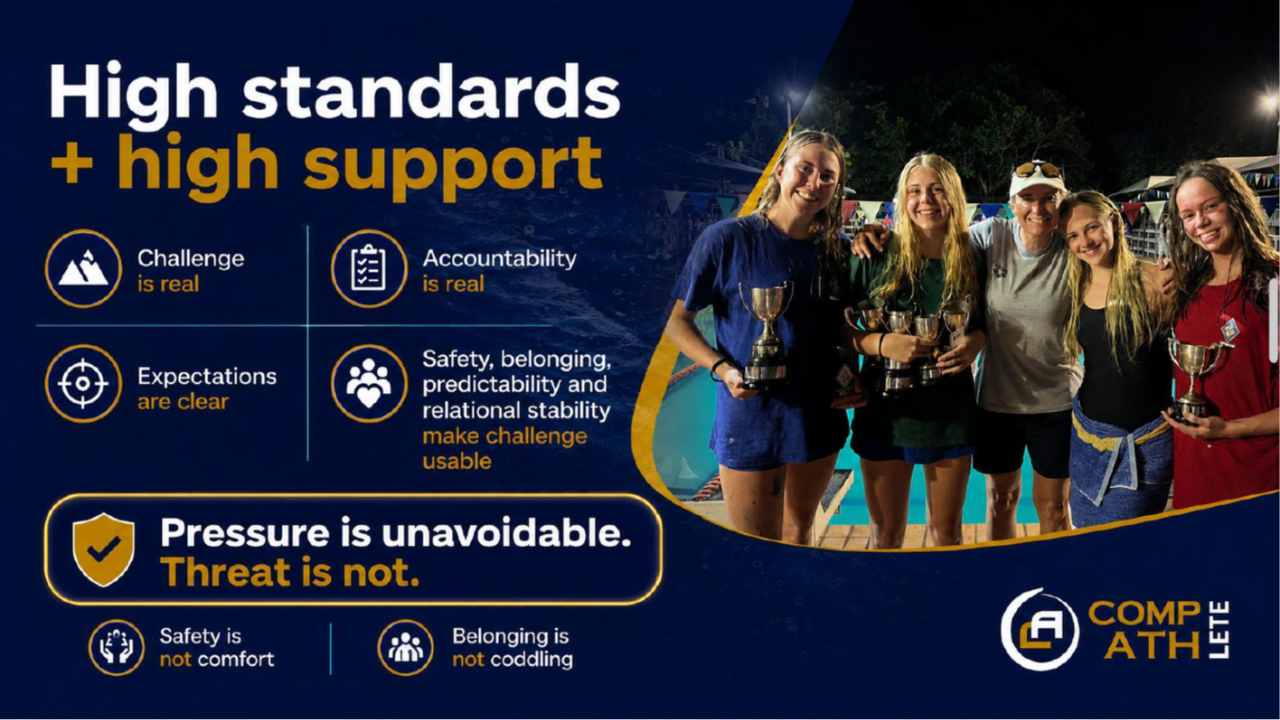
We should be aiming for environments with high standards and high support. Not soft environments. Not chaotic environments. Not low-accountability environments. Environments where challenge is real, accountability is real, expectations are clear, and athletes also experience enough safety, belonging, predictability, and relational stability that they can use the challenge rather than merely survive it.
That is why belonging matters so much.
Belonging is not coddling. It is not weakness. It is not the opposite of toughness. In fact, it's performance-relevant, especially in adolescence, where shared goals, trust, emotional safety, and group standards can turn social intensity into a performance asset rather than a source of threat.
Put simply:
Pressure is unavoidable. Threat is not.
A better question for parents and coaches
Instead of asking only, “Is this athlete tough enough?”
Try asking:
- Is this environment teaching real resilience, or just the appearance of coping?
- Is this athlete learning how to stay in the task under pressure?
- Are we helping them focus on what they can control?
- Are we building ownership, clarity, and confidence?
- Is this challenge stretching them, or just scrambling them?
Those questions get us much closer to the kind of development that actually lasts.
Where Complete Athlete can help
At Complete Athlete, this is exactly the work we care about.
Our coach resources are designed to help coaches build better performance environments — ones that support focus, confidence, ownership, and high-quality work rather than just more noise or more pressure. The Flow State Triggers for Swim Coaches guide, for example, is built around practical coaching cues, points of reference, and set design that help athletes stay engaged and take ownership inside training. It's available for free inside our Complete Athlete Collective Community.
On the athlete side, our strengths-first goal-setting approach helps athletes connect goals to the qualities they already bring under pressure, rather than building identity around deficits alone. The workbook emphasizes that athletes cannot control every outcome, but they can pursue goals in ways that leverage who they already are at their best. That work includes practical reflection on strengths, goals, process habits, reset plans, accountability, and weekly action planning — all of which support ownership and controllable focus.
If you are a parent or coach who wants to help young athletes:
- take ownership
- focus on what they can control
- build confidence without false shortcuts
- and create more positive, repeatable performance experiences
then we’d love to help.
Explore our programs and resources to see how Complete Athlete can support athletes and coaches in building clarity, ownership, resilience, and healthier high-performance experiences.